Categories
- Antiques & Collectibles 13
- Architecture 36
- Art 48
- Bibles 22
- Biography & Autobiography 816
- Body, Mind & Spirit 145
- Business & Economics 32
- Children's Books 15
- Children's Fiction 13
- Computers 4
- Cooking 94
- Crafts & Hobbies 4
- Drama 346
- Education 65
- Family & Relationships 62
- Fiction 11848
- Foreign Language Study 2
- Games 19
- Gardening 17
- Health & Fitness 36
- History 1383
- House & Home 1
- Humor 147
- Juvenile Fiction 1884
- Juvenile Nonfiction 202
- Language Arts & Disciplines 89
- Law 16
- Literary Collections 687
- Literary Criticism 179
- Mathematics 13
- Medical 43
- Music 40
- Nature 181
- Non-Classifiable 1768
- Performing Arts 7
- Periodicals 1453
- Philosophy 65
- Photography 2
- Poetry 898
- Political Science 206
- Psychology 44
- Reference 154
- Religion 516
- Science 128
- Self-Help 89
- Social Science 84
- Sports & Recreation 34
- Study Aids 3
- Technology & Engineering 60
- Transportation 23
- Travel 463
- True Crime 29
Our website is made possible by displaying online advertisements to our visitors.
Please consider supporting us by disabling your ad blocker.
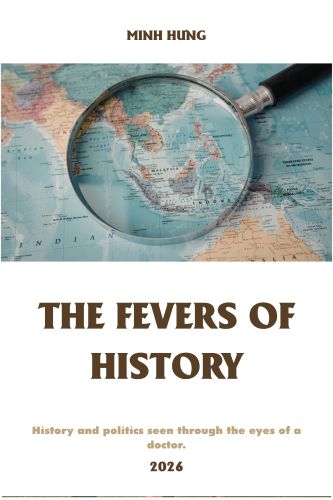
THE FEVERS OF HISTORY
by: Nguyễn Đông Hưng
Download options:
-

391.21 KB -

1.80 MB
Description:
The Fevers of History is a distinctive work of historical and political nonfiction that reads the past through the eyes of a physician. Instead of treating history as a dry chronology of kings, wars, empires, and revolutions, Minh Hung / Nguyen Dong Hung approaches civilizations as living political bodies: with symptoms, vital signs, medical histories, immune responses, crises, recoveries, and scars.
From Hammurabi’s law code and the political theater of ancient Babylon to Athens and the fever of democracy, from the fall of the Roman Republic to the centralizing power of Qin China, from Sima Qian’s wounded memory to Dai Viet’s struggle for legitimacy, from Machiavelli and raison d’État to the French Revolution, Lenin, Stalin, Hitler, Mao, Gandhi, Mandela, Vietnam’s Đổi Mới reforms, and the modern political fevers of the United States, China, and Vietnam, this book offers a sweeping yet deeply human interpretation of history.
Each chapter is structured like a “historical medical record.” The patient may be a city-state, an empire, a dynasty, a republic, a revolutionary movement, or a modern nation-state. The symptoms may appear as debt, famine, war, political violence, loss of legitimacy, ideological fever, social fragmentation, or the silencing of intellectuals. The diagnosis is never simplistic: centralization may bring efficiency but reduce feedback; reform may be necessary but administered at the wrong dose; revolution may liberate but also devour itself; development may reduce poverty while producing loneliness, inequality, and distrust.
Written in a literary yet evidence-conscious style, The Fevers of History combines storytelling, political analysis, historical interpretation, and medical metaphor. It asks urgent questions: What gives power its backbone? Why do republics collapse when procedures lose credibility? Why do empires sometimes die from political autoimmunity? What role do intellectuals play in the immune system of society? How can public memory help a nation recover without imprisoning it in the past? And how can history help human beings lower the political fevers of the future?
This book is for readers who love history, political thought, world civilizations, and Vietnam’s place in global historical reflection. It is also for anyone who believes that the past does not offer a magic cure, but can teach us how to recognize the symptoms of power before the fever becomes delirium.