Categories
- Antiques & Collectibles 13
- Architecture 36
- Art 48
- Bibles 22
- Biography & Autobiography 815
- Body, Mind & Spirit 144
- Business & Economics 28
- Children's Books 15
- Children's Fiction 12
- Computers 4
- Cooking 94
- Crafts & Hobbies 4
- Drama 346
- Education 63
- Family & Relationships 59
- Fiction 11841
- Foreign Language Study 1
- Games 19
- Gardening 17
- Health & Fitness 35
- History 1382
- House & Home 1
- Humor 147
- Juvenile Fiction 1877
- Juvenile Nonfiction 202
- Language Arts & Disciplines 89
- Law 16
- Literary Collections 687
- Literary Criticism 179
- Mathematics 13
- Medical 43
- Music 40
- Nature 181
- Non-Classifiable 1768
- Performing Arts 7
- Periodicals 1453
- Philosophy 65
- Photography 2
- Poetry 897
- Political Science 205
- Psychology 44
- Reference 154
- Religion 516
- Science 128
- Self-Help 86
- Social Science 83
- Sports & Recreation 34
- Study Aids 3
- Technology & Engineering 60
- Transportation 23
- Travel 463
- True Crime 29
Our website is made possible by displaying online advertisements to our visitors.
Please consider supporting us by disabling your ad blocker.
BOREDOM AND CREATIVITY
by: Nguyễn Đông Hưng
Categories:
Download options:
-

6.12 MB
Description:
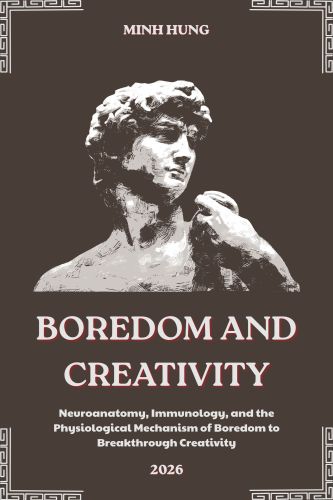
Boredom and Creativity: Neuroanatomy, Immunology, and Physiological Mechanisms of Boredom to Breakthrough Creativity by Minh Hung / Nguyen Dong Hung is an interdisciplinary work that brings together neuroscience, immunology, psychology, existential philosophy, and creativity studies to explore a profoundly modern question: why do boredom, emptiness, and stagnation sometimes become the starting point of breakthrough creativity?
Rather than treating boredom as merely a negative emotion, the book examines it as a complex biological and psychological state in which the brain temporarily withdraws from external stimulation in order to reorganize its internal cognitive resources. From the Default Mode Network (DMN), Central Executive Network (CEN), Salience Network (SN), and the Locus Coeruleus–Norepinephrine (LC-NE) system, to mechanisms such as Flow State, Transient Hypofrontality, Hypnagogia, alpha, theta, and gamma brain waves, and the elusive “Aha!” moment, the author presents a scientific map of how the brain moves from silence to creative intuition.
One of the distinctive strengths of Boredom and Creativity is its narrative voice, which combines personal experience, medical expertise, and humanistic reflection. As a surgeon and urologist who has experienced military life, clinical pressure, family challenges, psychological crises, and a transition toward humanistic inquiry, Minh Hung / Dr. Nguyen Dong Hung views boredom not only as a neurological phenomenon but also as an existential landscape where individuals may either disintegrate or be transformed.
The book also places boredom within the context of the digital age, where people are constantly stimulated by social media, technology, notifications, short-term dopamine rewards, and fragmented attention. In such an environment, the ability to tolerate silence, embrace creative solitude, and remain in moments of “doing nothing” becomes increasingly rare. Properly understood, boredom is no longer the enemy of productivity; it becomes a necessary biological pause that allows the mind to shift from consumption to creation.
Structured into seven sections and twenty chapters, the book guides readers through multiple layers of analysis: from existential reflections on emptiness, the role of the DMN in autobiographical thinking, the LC-NE system in behavioral transitions, flow states, hypnagogia and N1 sleep, to neuroimmunology, neuroinflammation, the blood–brain barrier, cortisol, cytokines, cellular aging, and cognitive resilience.
Boredom and Creativity is ideal for readers interested in neuroscience, creativity research, boredom psychology, flow states, hypnagogia, medical humanities, neuroimmunology, stress biology, dopamine fasting, digital-age mental health, and humanistic neuroscience.
This is not simply a book about boredom. It is an attempt to explain why, in the moments when people feel most trapped, the brain may actually be quietly preparing for its deepest and most transformative creative leap.