Categories
- Antiques & Collectibles 13
- Architecture 36
- Art 48
- Bibles 22
- Biography & Autobiography 816
- Body, Mind & Spirit 145
- Business & Economics 32
- Children's Books 15
- Children's Fiction 13
- Computers 4
- Cooking 94
- Crafts & Hobbies 4
- Drama 346
- Education 65
- Family & Relationships 62
- Fiction 11848
- Foreign Language Study 2
- Games 19
- Gardening 17
- Health & Fitness 36
- History 1383
- House & Home 1
- Humor 147
- Juvenile Fiction 1884
- Juvenile Nonfiction 202
- Language Arts & Disciplines 89
- Law 16
- Literary Collections 687
- Literary Criticism 179
- Mathematics 13
- Medical 43
- Music 40
- Nature 181
- Non-Classifiable 1768
- Performing Arts 7
- Periodicals 1453
- Philosophy 65
- Photography 2
- Poetry 898
- Political Science 206
- Psychology 44
- Reference 154
- Religion 516
- Science 128
- Self-Help 89
- Social Science 84
- Sports & Recreation 34
- Study Aids 3
- Technology & Engineering 60
- Transportation 23
- Travel 463
- True Crime 29
Our website is made possible by displaying online advertisements to our visitors.
Please consider supporting us by disabling your ad blocker.
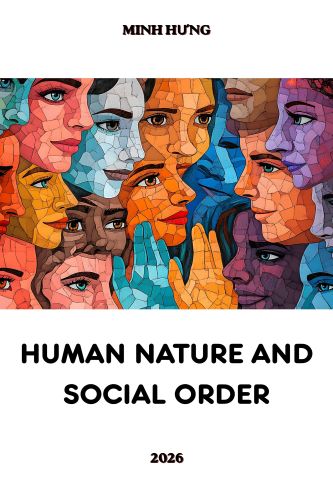
Human Nature and Social Order
by: Nguyễn Đông Hưng
Categories:
Download options:
-

298.14 KB -

1.07 MB
Description:
Human Nature and Social Order: The Political and Historical Laws of Society is a distinctive work of political philosophy, social theory, and humanistic reflection by Minh Hung / Nguyen Dong Hung. The book brings together Marxist political logic, Eastern philosophical foundations, Vietnamese historical consciousness, and a clinical medical way of thinking.
Rather than treating politics as a collection of slogans, events, or ideologies, the author approaches society as a living body. In this body, the state functions as the central nervous system, the economy as the bloodstream, culture as connective tissue, the moral core as the immune system, and the individual as a social cell shaped by power, class, history, and ideology.
Through this lens, the book explores essential questions of human nature, collective life, class consciousness, state power, political education, moral legitimacy, institutional decay, national defense, agricultural civilization, digital order, and the ideal of humanistic Great Unity.
This is not merely a book about politics. It is an anatomy of social existence for readers who want to understand why individuals obey, why power corrupts, why institutions rise and fall, and why every lasting social order must be rooted in the hearts of the people.