

Categories
- Antiques & Collectibles 13
- Architecture 36
- Art 48
- Bibles 22
- Biography & Autobiography 816
- Body, Mind & Spirit 145
- Business & Economics 32
- Children's Books 15
- Children's Fiction 13
- Computers 4
- Cooking 94
- Crafts & Hobbies 4
- Drama 346
- Education 64
- Family & Relationships 62
- Fiction 11848
- Foreign Language Study 2
- Games 19
- Gardening 17
- Health & Fitness 36
- History 1383
- House & Home 1
- Humor 147
- Juvenile Fiction 1884
- Juvenile Nonfiction 202
- Language Arts & Disciplines 89
- Law 16
- Literary Collections 687
- Literary Criticism 179
- Mathematics 13
- Medical 43
- Music 40
- Nature 181
- Non-Classifiable 1768
- Performing Arts 7
- Periodicals 1453
- Philosophy 65
- Photography 2
- Poetry 897
- Political Science 206
- Psychology 44
- Reference 154
- Religion 516
- Science 128
- Self-Help 89
- Social Science 84
- Sports & Recreation 34
- Study Aids 3
- Technology & Engineering 60
- Transportation 23
- Travel 463
- True Crime 29
Winston Churchill
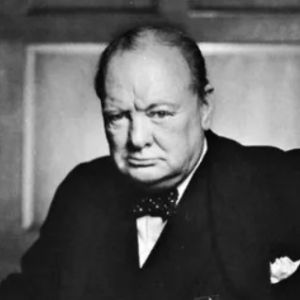
Winston Churchill, renowned primarily as a British statesman and Prime Minister during World War II, was also a prolific writer and historian. He authored numerous books, including "The Second World War" and "A History of the English-Speaking Peoples," which won him the Nobel Prize in Literature in 1953. Churchill's writing is celebrated for its eloquence, depth of historical insight, and vivid narrative style.
Author's Books:
Sort by:
CHAPTER I In this modern industrial civilization of which we are sometimes wont to boast, a certain glacier-like process may be observed. The bewildered, the helpless—and there are many—are torn from the parent rock, crushed, rolled smooth, and left stranded in strange places. Thus was Edward Bumpus severed and rolled from the ancestral ledge, from the firm granite of seemingly stable and lasting...
more...
As the name of our city grew to be more and more a byword for sudden and fabulous wealth, not only were the Huns and the Slavs, the Czechs and the Greeks drawn to us, but it became the fashion for distinguished Englishmen and Frenchmen and sometimes Germans and Italians to pay us a visit when they made the grand tour of America. They had been told that they must not miss us; scarcely a week went by in...
more...
My name is Hugh Paret. I was a corporation lawyer, but by no means a typical one, the choice of my profession being merely incidental, and due, as will be seen, to the accident of environment. The book I am about to write might aptly be called The Autobiography of a Romanticist. In that sense, if in no other, I have been a typical American, regarding my country as the happy hunting-ground of...
more...
My name is Hugh Paret. I was a corporation lawyer, but by no means a typical one, the choice of my profession being merely incidental, and due, as will be seen, to the accident of environment. The book I am about to write might aptly be called The Autobiography of a Romanticist. In that sense, if in no other, I have been a typical American, regarding my country as the happy hunting-ground of...
more...
IN WHICH A MIRROR IS HELD UP Spring came to Highlawns, Eden tinted with myriad tender greens. Yellow-greens, like the beech boughs over the old wall, and gentle blue-greens, like the turf; and the waters of the lake were blue and white in imitation of the cloud-flecked sky. It seemed to Honora, as she sat on the garden bench, that the yellow and crimson tulips could not open wide enough their cups to...
more...
CHAPTER I ASCENDI Honora did not go back to Quicksands. Neither, in this modern chronicle, shall we. The sphere we have left, which we know is sordid, sometimes shines in the retrospect. And there came a time, after the excitement of furnishing the new house was over, when our heroine, as it were, swung for a time in space: not for a very long time; that month, perhaps, between autumn and winter. We...
more...
BELLEGARDE Miss Virginia Carvel came down the steps in her riding-habit. And Ned, who had been waiting in the street with the horses, obsequiously held his hand while his young mistress leaped into Vixen's saddle. Leaving the darkey to follow upon black Calhoun, she cantered off up the street, greatly to the admiration of the neighbor. They threw open their windows to wave at her, but Virginia...
more...
When William Wetherell and Cynthia had reached the last turn in the road in Northcutt's woods, quarter of a mile from Coniston, they met the nasal Mr. Samuel Price driving silently in the other direction. The word "silently" is used deliberately, because to Mr. Price appertained a certain ghostlike quality of flitting, and to Mr. Price's horse and wagon likewise. He drew up for a...
more...
CHAPTER I I was about to say that I had known the Celebrity from the time he wore kilts. But I see I shall have to amend that, because he was not a celebrity then, nor, indeed, did he achieve fame until some time after I had left New York for the West. In the old days, to my commonplace and unobserving mind, he gave no evidences of genius whatsoever. He never read me any of his manuscripts, which I can...
more...
HIS GRACE MAKES ADVANCES The next morning I began casting about as to what I should do next. There was no longer any chance of getting at the secret from Dorothy, if secret there were. Whilst I am ruminating comes a great battling at the street door, and Jack Comyn blew in like a gust of wind, rating me soundly for being a lout and a blockhead. "Zooks!" he cried, "I danced the soles off my...
more...