

Categories
- Antiques & Collectibles 13
- Architecture 36
- Art 48
- Bibles 22
- Biography & Autobiography 816
- Body, Mind & Spirit 145
- Business & Economics 32
- Children's Books 15
- Children's Fiction 13
- Computers 4
- Cooking 94
- Crafts & Hobbies 4
- Drama 346
- Education 68
- Family & Relationships 62
- Fiction 11845
- Foreign Language Study 2
- Games 19
- Gardening 17
- Health & Fitness 36
- History 1383
- House & Home 1
- Humor 147
- Juvenile Fiction 1884
- Juvenile Nonfiction 202
- Language Arts & Disciplines 89
- Law 16
- Literary Collections 687
- Literary Criticism 180
- Mathematics 13
- Medical 43
- Music 40
- Nature 181
- Non-Classifiable 1768
- Performing Arts 7
- Periodicals 1453
- Philosophy 65
- Photography 2
- Poetry 898
- Political Science 206
- Psychology 44
- Reference 154
- Religion 516
- Science 128
- Self-Help 89
- Social Science 84
- Sports & Recreation 34
- Study Aids 3
- Technology & Engineering 60
- Transportation 23
- Travel 463
- True Crime 29
Plato (spurious and doubtful works)
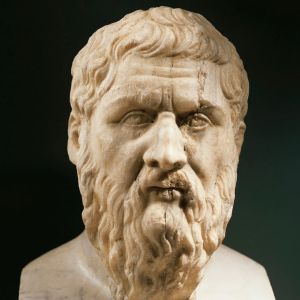
Plato was an ancient Greek philosopher, born around 427 BCE, and is considered one of the most influential figures in Western philosophy. He was a student of Socrates and the teacher of Aristotle, and his works explore topics like ethics, politics, metaphysics, and epistemology. Plato is best known for his dialogues, including "The Republic," which presents his vision of an ideal society, and "The Symposium," which discusses love and beauty. His concept of the "Theory of Forms" posits that the material world is a reflection of a higher, unchanging reality.
Author's Books:
Sort by:
APPENDIX II. The two dialogues which are translated in the second appendix are not mentioned by Aristotle, or by any early authority, and have no claim to be ascribed to Plato. They are examples of Platonic dialogues to be assigned probably to the second or third generation after Plato, when his writings were well known at Athens and Alexandria. They exhibit considerable originality, and are remarkable...
more...
APPENDIX I. It seems impossible to separate by any exact line the genuine writings of Plato from the spurious. The only external evidence to them which is of much value is that of Aristotle; for the Alexandrian catalogues of a century later include manifest forgeries. Even the value of the Aristotelian authority is a good deal impaired by the uncertainty concerning the date and authorship of the...
more...