

Categories
- Antiques & Collectibles 13
- Architecture 36
- Art 48
- Bibles 22
- Biography & Autobiography 815
- Body, Mind & Spirit 145
- Business & Economics 28
- Children's Books 15
- Children's Fiction 12
- Computers 4
- Cooking 94
- Crafts & Hobbies 4
- Drama 346
- Education 63
- Family & Relationships 59
- Fiction 11841
- Foreign Language Study 1
- Games 19
- Gardening 17
- Health & Fitness 35
- History 1382
- House & Home 1
- Humor 147
- Juvenile Fiction 1884
- Juvenile Nonfiction 202
- Language Arts & Disciplines 89
- Law 16
- Literary Collections 687
- Literary Criticism 179
- Mathematics 13
- Medical 43
- Music 40
- Nature 181
- Non-Classifiable 1768
- Performing Arts 7
- Periodicals 1453
- Philosophy 65
- Photography 2
- Poetry 897
- Political Science 205
- Psychology 44
- Reference 154
- Religion 516
- Science 128
- Self-Help 87
- Social Science 83
- Sports & Recreation 34
- Study Aids 3
- Technology & Engineering 60
- Transportation 23
- Travel 463
- True Crime 29
Louis Becke
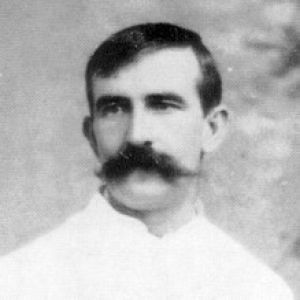
Louis Becke was an Australian writer known for his adventure stories set in the South Pacific. Born in 1855, he drew heavily on his own experiences as a trader, beachcomber, and government agent in the Pacific islands, which lent authenticity to his vivid tales. Becke's works, such as "By Reef and Palm" and "The Ebbing of the Tide," were popular in the late 19th and early 20th centuries, capturing the imaginations of readers with their exotic settings and adventurous plots.
Author's Books:
Sort by:

by:
Louis Becke
Crossing from Holyhead to Ireland one night the captain of the steamer and myself, during an hour's talk on the bridge, found that we each had sailed in a certain Australian coasting steamer more than twenty years before—he as chief officer and I as passenger; and her shipwreck one Christmas Eye (long after), which was attended by an appalling loss of life, led us to talk of "pig-headed"...
more...

by:
Louis Becke
Early one morning, just as the trade wind began to lift the white mountain mist which enveloped the dark valleys and mountain slopes of the island, Denison, the supercargo of the trading schooner Palestine, put off from her side and was pulled ashore to the house of the one white trader. The man's name was Handle, and as he heard the supercargo's footstep he came to the door and bade him good...
more...

by:
Louis Becke
RÍDAN THE DEVIL RÃdan lived alone in a little hut on the borders of the big German plantation at Mulifenua, away down at the lee end of Upolu Island, and every one of his brown-skinned fellow-workers either hated or feared him, and smiled when Burton, the American overseer, would knock him down for being a 'sulky brute.' But no one of them cared to let RÃdan see him smile. For to...
more...

by:
Louis Becke
Chapter I In that delightful and exciting book, written by Captain Joshua Slocum, and entitled, "Sailing Alone Round the World," there is a part wherein the adventurous American seaman relates how he protected himself from night attacks by the savages by a simple, but efficient precaution. It was his custom, when he anchored for the night off the snow-clad and inhospitable shores of Tierra del...
more...

by:
Louis Becke
To many people in England the mention of Australia conjures pictures of tented gold-fields and tall, black-bearded, red-shirted bushrangers; of mounted police recruited from "flaxen-haired younger sons of good old English families, well-groomed and typically Anglo-Saxon"; of squatters and sheep runs; of buckjumpers ridden by the most daring riders in the world; and of much more to the same...
more...
by:
Louis Becke
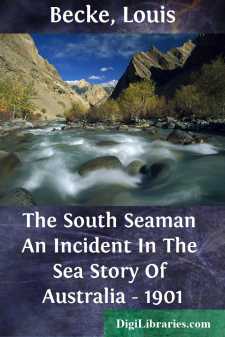
On the 22nd of July, 1828, the Sydney South Seaman, Indefatigable, eleven days out from the Port of Conception in Chili, was in lat 17? S. and about 127? E. long., six hundred miles distant from the nearest land—the then almost unknown Paumotu Group, which Cook had well named the Dangerous Archipelago. Five years before, the brig was named the Calder, and was then commanded by Captain Peter Dillon, a...
more...

by:
Louis Becke
"There," said Tâvita the teacher, pointing with his paddle to a long, narrow peninsula which stretched out into the shallow waters of the lagoon, "there, that is the place where the battle was fought. In those days a village of thirty houses or more stood there; now no one liveth there, and only sometimes do the people come here to gather cocoanuts." The White Man nodded....
more...

by:
Louis Becke
CHAPTER I ~ "CHINKIE'S FLAT" "Chinkie's Flat," In its decadence, was generally spoken of, by the passing traveller, as a "God-forsaken hole," and it certainly did present a repellent appearance when seen for the first time, gasping under the torrid rays of a North Queensland sun, which had dried up every green thing except the silver-leaved ironbarks, and the long,...
more...

by:
Louis Becke
Late one evening, when the native village was wrapped in slumber, Temana and I brought our sleeping-mats down to the boat-shed, and spread them upon the white, clinking sand. For here, out upon the open beach, we could feel a breath of the cooling sea-breeze, denied to the village houses by reason of the thick belt of palms which encompassed them on three sides. And then we were away from Malepa's...
more...

by:
Louis Becke
CHAPTER I Brabant's wife was sitting on the shady verandah of her house on the hills overlooking Levuka harbour, and watching a large fore and aft schooner being towed in by two boats, for the wind had died away early in the morning and left the smooth sea to swelter and steam under a sky of brass. The schooner was named the Maritana, and was owned and commanded by Mrs. Brabant's husband,...
more...