

Categories
- Antiques & Collectibles 13
- Architecture 36
- Art 48
- Bibles 22
- Biography & Autobiography 816
- Body, Mind & Spirit 145
- Business & Economics 32
- Children's Books 15
- Children's Fiction 13
- Computers 4
- Cooking 94
- Crafts & Hobbies 4
- Drama 346
- Education 64
- Family & Relationships 62
- Fiction 11848
- Foreign Language Study 2
- Games 19
- Gardening 17
- Health & Fitness 36
- History 1383
- House & Home 1
- Humor 147
- Juvenile Fiction 1884
- Juvenile Nonfiction 202
- Language Arts & Disciplines 89
- Law 16
- Literary Collections 687
- Literary Criticism 179
- Mathematics 13
- Medical 43
- Music 40
- Nature 181
- Non-Classifiable 1768
- Performing Arts 7
- Periodicals 1453
- Philosophy 65
- Photography 2
- Poetry 897
- Political Science 206
- Psychology 44
- Reference 154
- Religion 516
- Science 128
- Self-Help 89
- Social Science 84
- Sports & Recreation 34
- Study Aids 3
- Technology & Engineering 60
- Transportation 23
- Travel 463
- True Crime 29
J. M. (John Mackinnon) Robertson
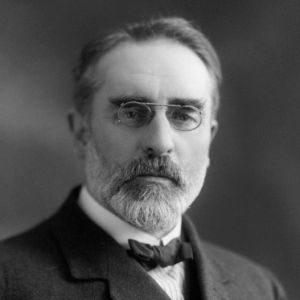
John Mackinnon Robertson (1856–1933) was a Scottish journalist, politician, and writer, known for his contributions to secularism, rationalism, and literary criticism. He was a prominent member of the British freethought movement and wrote extensively on religion, philosophy, and history. Among his well-known works are "A Short History of Freethought" and "Pagan Christs," in which he challenged religious orthodoxy and examined the origins of Christian doctrines. Robertson also served as a Liberal Member of Parliament, advocating for free trade, educational reform, and women's suffrage.
Author's Books:
Sort by:
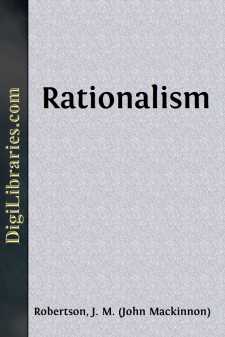
§ 1. THE TERM The names ‘rationalist’ and ‘rationalism’ have been used in so many senses within the past three hundred years that they cannot be said to stand quite definitely for any type or school of philosophic thought. For Bacon, a ‘rationalist’ or rationalis was a physician with a priori views of disease and bodily function; and the Aristotelian humanists of the Helmstadt school were...
more...
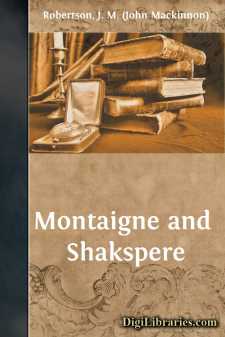
MONTAIGNE AND SHAKSPERE For a good many years past the anatomic study of Shakspere, of which a revival seems now on foot, has been somewhat out of fashion, as compared with its vogue in the palmy days of the New Shakspere Society in England, and the years of the battle between the iconoclasts and the worshippers in Germany. When Mr. Fleay and Mr. Spedding were hard at work on the metrical tests; when...
more...