

Categories
- Antiques & Collectibles 13
- Architecture 36
- Art 48
- Bibles 22
- Biography & Autobiography 813
- Body, Mind & Spirit 142
- Business & Economics 28
- Children's Books 17
- Children's Fiction 14
- Computers 4
- Cooking 94
- Crafts & Hobbies 4
- Drama 346
- Education 46
- Family & Relationships 57
- Fiction 11829
- Games 19
- Gardening 17
- Health & Fitness 34
- History 1377
- House & Home 1
- Humor 147
- Juvenile Fiction 1873
- Juvenile Nonfiction 202
- Language Arts & Disciplines 88
- Law 16
- Literary Collections 686
- Literary Criticism 179
- Mathematics 13
- Medical 41
- Music 40
- Nature 179
- Non-Classifiable 1768
- Performing Arts 7
- Periodicals 1453
- Philosophy 64
- Photography 2
- Poetry 896
- Political Science 203
- Psychology 42
- Reference 154
- Religion 513
- Science 126
- Self-Help 84
- Social Science 81
- Sports & Recreation 34
- Study Aids 3
- Technology & Engineering 59
- Transportation 23
- Travel 463
- True Crime 29
William Graham Sumner
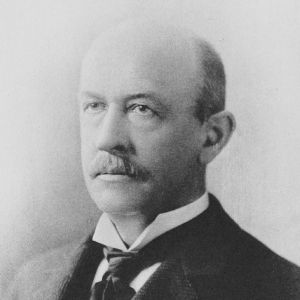
William Graham Sumner (1840–1910) was a prominent American social scientist, professor, and classical liberal intellectual. He is best known for his works on sociology and political economy, where he advocated for laissez-faire economics and social Darwinism. Sumner authored influential books such as "What Social Classes Owe to Each Other" and "Folkways," the latter of which explored the concept of customs and norms shaping societies. His ideas often emphasized individual liberty, limited government, and the belief that social evolution occurs naturally without state intervention.
Author's Books:
Sort by:

INTRODUCTION We are told every day that great social problems stand before us and demand a solution, and we are assailed by oracles, threats, and warnings in reference to those problems. There is a school of writers who are playing quite a rôle as the heralds of the coming duty and the coming woe. They assume to speak for a large, but vague and undefined, constituency, who set the task, exact a...
more...
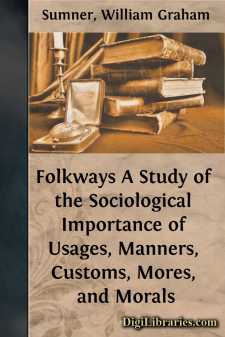
PREFACE In 1899 I began to write out a text-book of sociology from material which I had used in lectures during the previous ten or fifteen years. At a certain point in that undertaking I found that I wanted to introduce my own treatment of the "mores." I could not refer to it anywhere in print, and I could not do justice to it in a chapter of another book. I therefore turned aside to write a...
more...