

Categories
- Antiques & Collectibles 13
- Architecture 36
- Art 48
- Bibles 22
- Biography & Autobiography 816
- Body, Mind & Spirit 145
- Business & Economics 32
- Children's Books 15
- Children's Fiction 13
- Computers 4
- Cooking 94
- Crafts & Hobbies 4
- Drama 346
- Education 65
- Family & Relationships 62
- Fiction 11848
- Foreign Language Study 2
- Games 19
- Gardening 17
- Health & Fitness 36
- History 1383
- House & Home 1
- Humor 147
- Juvenile Fiction 1884
- Juvenile Nonfiction 202
- Language Arts & Disciplines 89
- Law 16
- Literary Collections 687
- Literary Criticism 179
- Mathematics 13
- Medical 43
- Music 40
- Nature 181
- Non-Classifiable 1768
- Performing Arts 7
- Periodicals 1453
- Philosophy 65
- Photography 2
- Poetry 898
- Political Science 206
- Psychology 44
- Reference 154
- Religion 516
- Science 128
- Self-Help 89
- Social Science 84
- Sports & Recreation 34
- Study Aids 3
- Technology & Engineering 60
- Transportation 23
- Travel 463
- True Crime 29
Henry Hallam
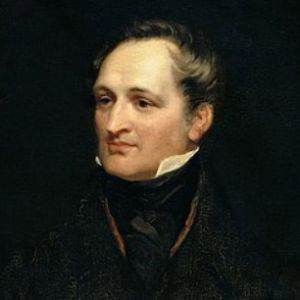
Henry Hallam (1777–1859) was an English historian and writer known for his comprehensive works on European history. His most notable books include "The Constitutional History of England," where he examined the development of the English government from Henry VII to George II, and "View of the State of Europe during the Middle Ages," which provided a broad survey of European history during the medieval period. Hallam's work is characterized by its thorough research, critical analysis, and impartial perspective. He also authored "Introduction to the Literature of Europe in the Fifteenth, Sixteenth, and Seventeenth Centuries," contributing significantly to the study of literary history.
Author's Books:
Sort by:
by:
Henry Hallam
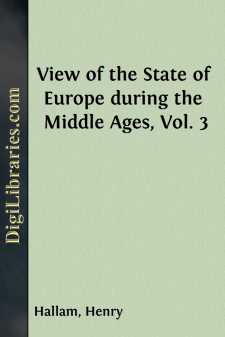
Reign of Edward I.—Confirmatio Chartarum—Constitution of Parliament—the Prelates—the Temporal Peers—Tenure by Barony—its Changes—Difficulty of the Subject—Origin of Representation of the Commons—Knights of Shires—their Existence doubtfully traced through the Reign of Henry III.—Question whether Representation was confined to Tenants in capite discussed—State of English Towns at...
more...