

Categories
- Antiques & Collectibles 13
- Architecture 36
- Art 48
- Bibles 22
- Biography & Autobiography 815
- Body, Mind & Spirit 144
- Business & Economics 28
- Children's Books 15
- Children's Fiction 11
- Computers 4
- Cooking 94
- Crafts & Hobbies 4
- Drama 346
- Education 62
- Family & Relationships 59
- Fiction 11838
- Foreign Language Study 1
- Games 19
- Gardening 17
- Health & Fitness 35
- History 1381
- House & Home 1
- Humor 147
- Juvenile Fiction 1873
- Juvenile Nonfiction 202
- Language Arts & Disciplines 89
- Law 16
- Literary Collections 687
- Literary Criticism 179
- Mathematics 13
- Medical 43
- Music 40
- Nature 180
- Non-Classifiable 1768
- Performing Arts 7
- Periodicals 1453
- Philosophy 65
- Photography 2
- Poetry 897
- Political Science 205
- Psychology 44
- Reference 154
- Religion 515
- Science 127
- Self-Help 86
- Social Science 83
- Sports & Recreation 34
- Study Aids 3
- Technology & Engineering 60
- Transportation 23
- Travel 463
- True Crime 29
Aquinas Thomas
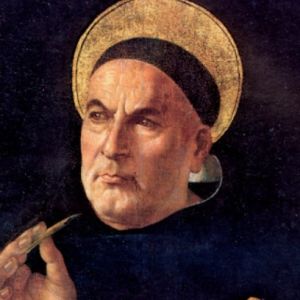
Thomas Aquinas was a 13th-century Catholic philosopher and theologian, considered one of the most influential figures in Western thought. His major work, "Summa Theologica," is a comprehensive exploration of Christian theology and philosophy, addressing topics like the existence of God, morality, and law. Aquinas developed a synthesis of Aristotelian philosophy and Christian doctrine, which became a foundation for Scholasticism. He was canonized as a saint and later declared a Doctor of the Church for his significant contributions to theology.
Author's Books:
Sort by:
by:
Aquinas Thomas
TREATISE ON THE THEOLOGICAL VIRTUES (QQ. 1-46) _______________________ QUESTION 1 OF FAITH (In Ten Articles) Having to treat now of the theological virtues, we shall begin withFaith, secondly we shall speak of Hope, and thirdly, of Charity. The treatise on Faith will be fourfold: (1) Of faith itself; (2) Of the corresponding gifts, knowledge and understanding; (3) Of the opposite vices; (4) Of the...
more...
by:
Aquinas Thomas
FIRST ARTICLE [I-II, Q. 1, Art. 1] Whether It Belongs to Man to Act for an End? Objection 1: It would seem that it does not belong to man to act for an end. For a cause is naturally first. But an end, in its very name, implies something that is last. Therefore an end is not a cause. But that for which a man acts, is the cause of his action; since this preposition "for" indicates a relation of...
more...
by:
Aquinas Thomas
In a few places, where obvious errors appeared in the Benziger Brothers edition, I have corrected them by reference to a Latin text of the Summa. These corrections are indicated by English text in brackets. For example, in Part I, Question 45, Article 2, the first sentence in the Benziger Brothers edition begins: "Not only is it impossible that anything should be created by God…." By...
more...
by:
Aquinas Thomas
PROLOGUE Because the Master of Catholic Truth ought not only to teach the proficient, but also to instruct beginners (according to the Apostle: As Unto Little Ones in Christ, I Gave You Milk to Drink, Not Meat— 1 Cor. iii. 1, 2)—we purpose in this book to treat of whatever belongs to the Christian Religion, in such a way as may tend to the instruction of beginners. We have considered that students...
more...