Categories
- Antiques & Collectibles 13
- Architecture 36
- Art 48
- Bibles 22
- Biography & Autobiography 816
- Body, Mind & Spirit 145
- Business & Economics 32
- Children's Books 15
- Children's Fiction 13
- Computers 4
- Cooking 94
- Crafts & Hobbies 4
- Drama 346
- Education 69
- Family & Relationships 62
- Fiction 11845
- Foreign Language Study 2
- Games 19
- Gardening 17
- Health & Fitness 36
- History 1383
- House & Home 1
- Humor 147
- Juvenile Fiction 1884
- Juvenile Nonfiction 202
- Language Arts & Disciplines 89
- Law 16
- Literary Collections 687
- Literary Criticism 180
- Mathematics 13
- Medical 43
- Music 40
- Nature 181
- Non-Classifiable 1768
- Performing Arts 7
- Periodicals 1453
- Philosophy 65
- Photography 2
- Poetry 898
- Political Science 208
- Psychology 44
- Reference 154
- Religion 516
- Science 128
- Self-Help 89
- Social Science 84
- Sports & Recreation 34
- Study Aids 3
- Technology & Engineering 60
- Transportation 23
- Travel 463
- True Crime 29
Our website is made possible by displaying online advertisements to our visitors.
Please consider supporting us by disabling your ad blocker.
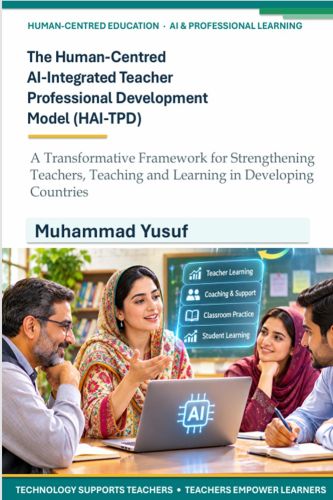
The Human-Centred AI-Integrated Teacher Professional Development Model (HAI-TPD)
by: Muhammad Yusuf
Download options:
-

1.41 MB
Description:
Teacher professional development stands at a critical crossroads. Across developing countries, education systems continue to invest in teacher training, yet the gap between participation in professional development and meaningful improvement in classroom practices remains substantial. At the same time, artificial intelligence is rapidly transforming how knowledge is created, accessed, and applied, presenting both opportunities and challenges for the teaching profession.
This book, The Human-Centred AI-Integrated Teacher Professional Development Model (HAI TPD), emerges from a fundamental conviction: the future of education must be built around empowered teachers, not technological dependence.
The proposed HAI-TPD model brings together established principles of effective professional learning, school-based coaching, reflective practice, competency development, and responsible AI integration. It positions teachers as active professionals, instructional mentors as essential human partners, and artificial intelligence as a supportive resource rather than a substitute for professional judgement.
Particular attention is given to the realities of developing countries, where rural schools, multigrade classrooms, linguistic diversity, limited connectivity, and institutional constraints demand practical and affordable solutions. Drawing upon international research and illustrative educational scenarios, the book connects conceptual understanding with classroom application, ethical safeguards, institutional arrangements, financing, and long-term sustainability.
Importantly, HAI-TPD is presented as a proposed framework requiring systematic piloting, research, and validation, rather than an already proven intervention.
This book is intended for teachers, teacher educators, instructional coaches, educational leaders, policymakers, researchers, and development partners seeking to rethink professional learning in an AI-enabled world. Its central message is simple: technology should expand human possibilities, strengthen educational institutions, and help teachers respond more effectively to children's learning needs.
The ultimate measure of progress is not how intelligently our technologies perform, but how thoughtfully, confidently, and compassionately our teachers enable every child to learn.