

Categories
- Antiques & Collectibles 13
- Architecture 36
- Art 48
- Bibles 22
- Biography & Autobiography 816
- Body, Mind & Spirit 145
- Business & Economics 30
- Children's Books 15
- Children's Fiction 12
- Computers 4
- Cooking 94
- Crafts & Hobbies 4
- Drama 346
- Education 64
- Family & Relationships 59
- Fiction 11841
- Foreign Language Study 2
- Games 19
- Gardening 17
- Health & Fitness 35
- History 1383
- House & Home 1
- Humor 147
- Juvenile Fiction 1884
- Juvenile Nonfiction 202
- Language Arts & Disciplines 89
- Law 16
- Literary Collections 687
- Literary Criticism 179
- Mathematics 13
- Medical 43
- Music 40
- Nature 181
- Non-Classifiable 1768
- Performing Arts 7
- Periodicals 1453
- Philosophy 65
- Photography 2
- Poetry 897
- Political Science 205
- Psychology 44
- Reference 154
- Religion 516
- Science 128
- Self-Help 87
- Social Science 83
- Sports & Recreation 34
- Study Aids 3
- Technology & Engineering 60
- Transportation 23
- Travel 463
- True Crime 29
Our website is made possible by displaying online advertisements to our visitors.
Please consider supporting us by disabling your ad blocker.
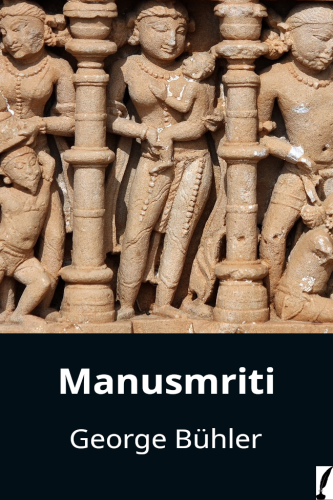
Manusmriti
by: George Buhler
Download options:
-

1.39 MB -

2.90 MB
Description:
Manusmriti is the foundational text that navigates the intricate tapestry of ancient Hindu society and jurisprudence. It is categorized under the Vedangas, which encompasses six auxiliary subjects to the Vedas. This text specifically comes under Kalpasutras — one such subject. Kalpasutras have four divisions: Srautasutras, Sulbasutras, Grihyasutras, and Dharmasutras. Srautasutras deal with the protocols of Vedic sacrifices, while Sulbasutras specifically deal with the formation of sacrificial altars and the associated mathematics. Grihyasutras address the rules of domestic rituals known as Samskaras, whereas Dharmasutras, also known as Dharmasastras or Smriti, expound the social codes. According to the Yajnavalkya Smriti 1.4-5, the promulgators of Dharmasastras include Manu, Atri, Vishnu, Harita, Yajnavalkya, Usana, Angira, Yama, Apastamva, Samvartta, Katyayana, Vrihaspati, Parasara, Vyasa, Sankha, Likhita, Daksha, Gotama, Satatapa, and Vasishtha. Manusmriti is the oldest and most well-known among these texts and probably the most controversial.
Manusmriti was translated into English in 1886 by George Bühler as part of the Sacred Books of the East series. The original edition was named 'The Laws of Manu' and included a lengthy introduction, as well as extracts from seven commentaries on Manusmriti. In this EPUB edition, we have sourced the text from the original edition. However, we have not included the introduction and commentaries for the sake of brevity.
As readers, we must approach Manusmriti with a discerning lens, recognizing the societal nuances and cultural specifics of the time it was written. As society evolves, so should the rules governing it — a provision explicitly mentioned even in the Smriti texts. For instance, Yajnavalkya Smriti cautions against conducting rites censured by the people (Yajnavalkya Samhita 1.156).
In conclusion, Manusmriti stands as a testament to the enduring legacy of ancient Indian thought. However, the relevance of Manusmriti extends beyond its historical context. May this journey through its pages inspire introspection, dialogue, and a deeper understanding of the intricate threads that weave the fabric of our society.