

Categories
- Antiques & Collectibles 13
- Architecture 36
- Art 48
- Bibles 22
- Biography & Autobiography 815
- Body, Mind & Spirit 145
- Business & Economics 28
- Children's Books 15
- Children's Fiction 12
- Computers 4
- Cooking 94
- Crafts & Hobbies 4
- Drama 346
- Education 63
- Family & Relationships 59
- Fiction 11841
- Foreign Language Study 1
- Games 19
- Gardening 17
- Health & Fitness 35
- History 1382
- House & Home 1
- Humor 147
- Juvenile Fiction 1880
- Juvenile Nonfiction 202
- Language Arts & Disciplines 89
- Law 16
- Literary Collections 687
- Literary Criticism 179
- Mathematics 13
- Medical 43
- Music 40
- Nature 181
- Non-Classifiable 1768
- Performing Arts 7
- Periodicals 1453
- Philosophy 65
- Photography 2
- Poetry 897
- Political Science 205
- Psychology 44
- Reference 154
- Religion 516
- Science 128
- Self-Help 87
- Social Science 83
- Sports & Recreation 34
- Study Aids 3
- Technology & Engineering 60
- Transportation 23
- Travel 463
- True Crime 29
Hastings Rashdall
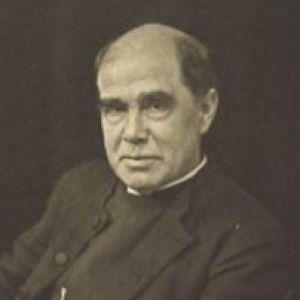
Hastings Rashdall (1858–1924) was an influential British philosopher and theologian known for his contributions to ethical theory and educational reform. He is best remembered for his work "The Theory of Good and Evil" (1907), where he developed an early form of ideal utilitarianism, arguing that moral actions are those that maximize good outcomes. Rashdall was also a historian and his book "The Universities of Europe in the Middle Ages" (1895) became a seminal text on medieval education. As a clergyman, he sought to reconcile Christian theology with philosophical ethics.
Author's Books:
Sort by:
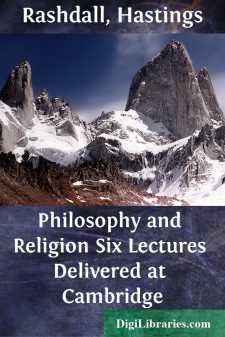
GENERAL INTRODUCTION TO THE SERIES Man has no deeper or wider interest than theology; none deeper, for however much he may change, he never loses his love of the many questions it covers; and none wider, for under whatever law he may live he never escapes from its spacious shade; nor does he ever find that it speaks to him in vain or uses a voice that fails to reach him. Once the present writer was...
more...