

Categories
- Antiques & Collectibles 13
- Architecture 36
- Art 48
- Bibles 22
- Biography & Autobiography 816
- Body, Mind & Spirit 145
- Business & Economics 30
- Children's Books 15
- Children's Fiction 12
- Computers 4
- Cooking 94
- Crafts & Hobbies 4
- Drama 346
- Education 64
- Family & Relationships 59
- Fiction 11841
- Foreign Language Study 2
- Games 19
- Gardening 17
- Health & Fitness 35
- History 1383
- House & Home 1
- Humor 147
- Juvenile Fiction 1884
- Juvenile Nonfiction 202
- Language Arts & Disciplines 89
- Law 16
- Literary Collections 687
- Literary Criticism 179
- Mathematics 13
- Medical 43
- Music 40
- Nature 181
- Non-Classifiable 1768
- Performing Arts 7
- Periodicals 1453
- Philosophy 65
- Photography 2
- Poetry 897
- Political Science 205
- Psychology 44
- Reference 154
- Religion 516
- Science 128
- Self-Help 87
- Social Science 83
- Sports & Recreation 34
- Study Aids 3
- Technology & Engineering 60
- Transportation 23
- Travel 463
- True Crime 29
Anthony Trollope
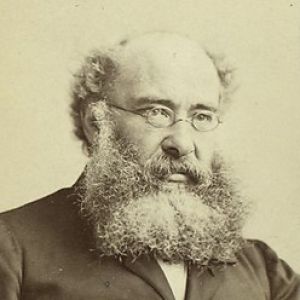
Anthony Trollope (1815-1882) was a prolific English novelist best known for his series of novels set in the fictional county of Barsetshire, including "Barchester Towers" and "The Last Chronicle of Barset." His works, often exploring the intricacies of Victorian society and politics, feature complex characters and detailed social commentary. Trollope also had a notable career in the British postal service, where he is credited with introducing the red pillar box (mailbox).
Author's Books:
Sort by:

by:
Anthony Trollope
CHAPTER I. INTRODUCTION. It may be doubted whether a brighter, more prosperous, and specially a more orderly colony than Britannula was ever settled by British colonists. But it had its period of separation from the mother country, though never of rebellion,—like its elder sister New Zealand. Indeed, in that respect it simply followed the lead given her by the Australias, which, when they set up...
more...

by:
Anthony Trollope
In vain, after that, did Anty try to sleep; turn which way she would, she saw the bloodshot eyes and horrid drunken face of her cruel brother. For a long time she lay, trembling and anxious; fearing she knew not what, and trying to compose herself—trying to make herself think that she had no present cause for fear; but in vain. If she heard a noise, she thought it was her brother's footstep, and...
more...
by:
Anthony Trollope
CHAPTER I. BALLYCLORAN HOUSE AS FIRST SEEN BY THE AUTHOR. In the autumn, 184—, business took me into the West of Ireland, and, amongst other places, to the quiet little village of Drumsna, which is in the province of Connaught, County Leitrim, about 72 miles w.n.w. of Dublin, on the mail-coach road to Sligo. I reached the little inn there in the morning by the said mail, my purpose being to leave...
more...

by:
Anthony Trollope
CHAPTER I. Three Editors Let the reader be introduced to Lady Carbury, upon whose character and doings much will depend of whatever interest these pages may have, as she sits at her writing-table in her own room in her own house in Welbeck Street. Lady Carbury spent many hours at her desk, and wrote many letters,—wrote also very much beside letters. She spoke of herself in these days as a woman...
more...
by:
Anthony Trollope
CHAPTER I Of course there was a Great House at Allington. How otherwise should there have been a Small House? Our story will, as its name imports, have its closest relations with those who lived in the less dignified domicile of the two; but it will have close relations also with the more dignified, and it may be well that I should, in the first instance, say a few words as to the Great House and its...
more...
by:
Anthony Trollope
Introduction. At a private asylum in the west of England there lives, and has lived for some years past, an unfortunate lady, as to whom there has long since ceased to be any hope that she should ever live elsewhere. Indeed, there is no one left belonging to her by whom the indulgence of such a hope on her behalf could be cherished. Friends she has none; and her own condition is such, that she recks...
more...
by:
Anthony Trollope
CHAPTER I. SHEWING HOW WRATH BEGAN. When Louis Trevelyan was twenty-four years old, he had all the world before him where to choose; and, among other things, he chose to go to the Mandarin Islands, and there fell in love with Emily Rowley, the daughter of Sir Marmaduke, the governor. Sir Marmaduke Rowley, at this period of his life, was a respectable middle-aged public servant, in good repute, who...
more...
by:
Anthony Trollope
CECILIA HOLT AND HER THREE FRIENDS. There came an episode in the life of Cecilia Holt which it is essential should first be told. When she was twenty-two years old she was living with her mother at Exeter. Mrs. Holt was a widow with comfortable means,—ample that is for herself and her daughter to supply them with all required by provincial comfort and provincial fashion. They had a house without...
more...
by:
Anthony Trollope
SIR HARRY HOTSPUR. Sir Harry Hotspur of Humblethwaite was a mighty person in Cumberland, and one who well understood of what nature were the duties, and of what sort the magnificence, which his position as a great English commoner required of him. He had twenty thousand a year derived from land. His forefathers had owned the same property in Cumberland for nearly four centuries, and an estate nearly...
more...
by:
Anthony Trollope
INTRODUCTORY.—NUMBER ONE. I would that it were possible so to tell a story that a reader should beforehand know every detail of it up to a certain point, or be so circumstanced that he might be supposed to know. In telling the little novelettes of our life, we commence our narrations with the presumption that these details are borne in mind, and though they be all forgotten, the stories come out...
more...