

History
- Africa 30
- Americas (North Central South West Indies) 50
- Ancient 69
- Asia 58
- Australia & New Zealand 8
- Canada 41
- Caribbean & West Indies 1
- Civilization 20
- Eastern Europe 12
- Europe 311
- Expeditions & Discoveries 60
- General
- Historical Geography 1
- Jewish 9
- Latin America 3
- Medieval 8
- Middle East 14
- Military 248
- Revolutionary 8
- Social History 1
- Study & Teaching 5
- United States 353
- Western Europe 56
- World 13
General Books
Sort by:

CHAPTER I THE EXPLANATION OF MATERIAL CHANGES GIVEN BY THE GREEK THINKERS. For thousands of years before men had any accurate and exact knowledge of the changes of material things, they had thought about these changes, regarded them as revelations of spiritual truths, built on them theories of things in heaven and earth (and a good many things in neither), and used them in manufactures, arts, and...
more...

by:
Andrew Lang
IDon't let your poor littleLizzie be blamed!Thackeray. 'Everyone has heard of the case of Elizabeth Canning,' writes Mr. John Paget; and till recently I agreed with him. But five or six years ago the case of Elizabeth Canning repeated itself in a marvellous way, and then but few persons of my acquaintance had ever heard of that mysterious girl. The recent case, so strange a parallel to...
more...

by:
Oliver Lodge
LECTURE I COPERNICUS AND THE MOTION OF THE EARTH The ordinary run of men live among phenomena of which they know nothing and care less. They see bodies fall to the earth, they hear sounds, they kindle fires, they see the heavens roll above them, but of the causes and inner working of the whole they are ignorant, and with their ignorance they are content. "Understand the structure of a...
more...
INTRODUCTION We can distinguish three kinds of astronomy, each with a different origin and history, but all mutually dependent, and composing, in their fundamental unity, one science. First in order of time came the art of observing the returns, and measuring the places, of the heavenly bodies. This was the sole astronomy of the Chinese and Chaldeans; but to it the vigorous Greek mind added a highly...
more...

It is now nearly forty years since I assisted my father, the late Charles W. Upham, in the preparation of his work on Salem Village and the Witchcraft tragedy of 1692, by collecting what information could be obtained from the records as to the people and their homes in that locality. In doing this I was enabled to construct a map showing the bounds of the grants and farms at that time. On that map is...
more...

PREFACE It is very difficult to write a preface to a work which is expressly intended as a revelation of the faith of the writer. The successive stages of thought and emotion that have been passed through are still too near, and one feels too deeply. I have made several futile attempts to concentrate into a short note the Truths about Woman that I have tried to convey in my book. I find it impossible...
more...

SAMUEL ELIOT History of the United States Samuel Eliot, a historian and educator, was born in Boston in 1821, graduated at Harvard in 1839, was engaged in business for two years, and then travelled and studied abroad for four years more. On his return, he took up tutoring and gave gratuitous instruction to classes of young workingmen. He became professor of history and political science in Trinity...
more...
by:
Hawre Qandil
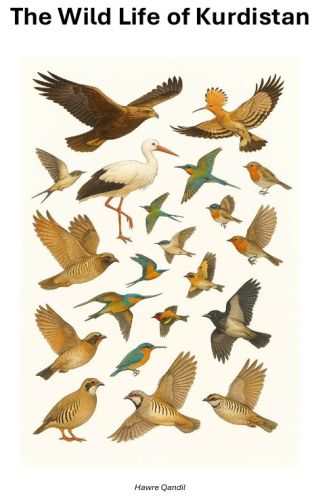
The Wildlife of Kurdistan is a rich and illuminating exploration of one of the Middle East’s most diverse yet least documented natural landscapes. From the high peaks of the Zagros Mountains to fertile valleys, rivers, forests, and plains, this book reveals the extraordinary biodiversity that has thrived in Kurdistan for thousands of years. Combining natural history, geography, and environmental...
more...

THE INN-YARDS BEFORE the building of regular playhouses the itinerant troupes of actors were accustomed, except when received into private homes, to give their performances in any place that chance provided, such as open street-squares, barns, town-halls, moot-courts, schoolhouses, churches, and—most frequently of all, perhaps—the yards of inns. These yards, especially those of carriers' inns,...
more...